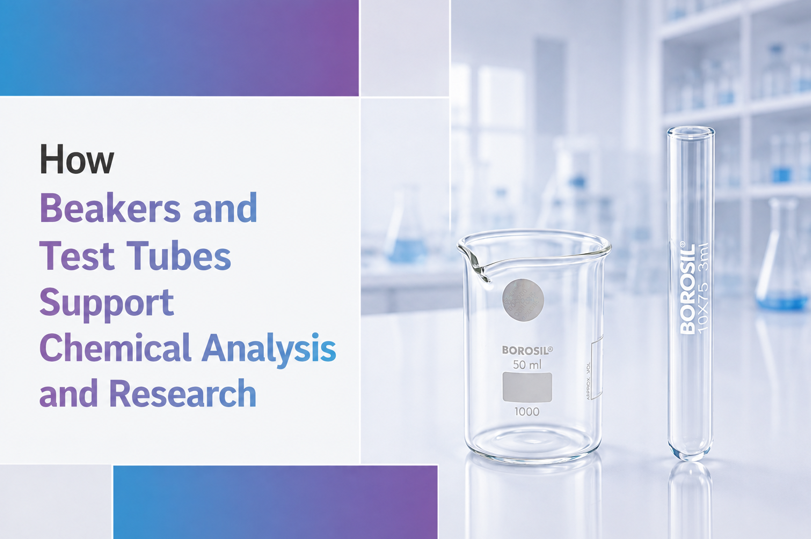
How Beakers and Test Tubes Support Chemical Analysis and Research
Chemical analysis depends on accurate methods, careful observation and suitable laboratory glassware and equipment. Among the most commonly used items are beakers and test tubes, which support different stages of experimental work. Beakers are typically used for preparing solutions, mixing reagents and transferring liquids, while a test tube is better suited to small-scale reactions and observation. Understanding how these vessels complement each other helps researchers select the appropriate glassware for reliable chemical analysis and consistent research outcomes.
How Beakers Support Chemical Analysis
Beakers are essential for many routine laboratory procedures because they can hold, mix and heat a wide range of chemical solutions. Researchers commonly use them to prepare reagents, dissolve solids and combine chemicals before experiments begin. Their wide opening also allows easy addition of materials during different stages of an experiment.
Beakers are available in various capacities, allowing researchers to select an appropriate size based on the volume required for a particular procedure. This flexibility makes them useful for preparing solutions, carrying out mixing tasks and handling liquids before they are transferred to other laboratory glassware for further analysis.
Their design supports efficient laboratory work. A flat base provides stability on laboratory benches and heating surfaces, while the pouring spout allows controlled liquid transfer and helps reduce spills. Low-form and tall-form beakers are selected according to the application. For example, Borosil Scientific offers machine-blown beakers manufactured from low-expansion borosilicate glass 3.3 with reinforced rims for improved durability and routine laboratory use.
How Test Tubes Support Chemical Research
A test tube is designed for experiments involving relatively small quantities of liquids or solids. Researchers use it to perform chemical reactions, observe colour changes, compare reaction outcomes and heat small sample volumes under controlled conditions. Its cylindrical shape also supports efficient mixing during laboratory procedures.
The compact size of a test tube allows several reactions to be carried out simultaneously without requiring large quantities of reagents. This makes it particularly useful for qualitative analysis, preliminary investigations and experiments where careful observation of small samples is important for accurate interpretation.
Different types of test tubes support different laboratory requirements. Flat-bottom tubes stand upright for observation, stoppered tubes help minimise contamination during temporary storage, and graduated tubes provide an approximate volume reference. Selecting the appropriate tube design helps researchers handle samples efficiently and maintain consistent experimental conditions.
How Beakers and Test Tubes Work Together in Laboratory Research
Many laboratory procedures require both beakers and test tubes because each performs a different role within the same analytical workflow. A researcher may first prepare and mix a solution in a beaker before transferring a measured portion into a tube for reaction, observation or comparison. Using each vessel for its intended purpose supports an organised workflow and reduces unnecessary handling during experiments.
| Laboratory Activity | Beaker | Test Tube |
| Preparing solutions | ✓ | |
| Mixing reagents | ✓ | ✓ |
| Heating liquids or samples | ✓ | ✓ |
| Performing small-scale reactions | ✓ | |
| Observing reaction changes | ✓ | |
| Transferring prepared solutions | ✓ | ✓ |
Together, these vessels support laboratory work from solution preparation to reaction analysis. Beakers simplify solution preparation and reagent handling, while test tubes provide a suitable environment for small-scale reactions and observations. Their complementary use allows researchers to perform chemical analysis in a logical and efficient sequence.
See also: How Intelligent Search Enhances Business Efficiency?
Why the Right Glassware Matters for Reliable Results
Selecting suitable laboratory glassware directly contributes to reliable chemical analysis. Choosing the appropriate vessel helps researchers mix, heat and transfer chemicals efficiently while reducing handling errors. The shape and capacity of laboratory glassware also influence how easily reactions can be observed and samples managed throughout an experiment.
The material used to manufacture laboratory glassware is equally important. Borosilicate glass is widely used because it offers good resistance to many laboratory chemicals and performs well during routine heating applications. These properties help laboratories carry out procedures involving heating and chemical handling with greater confidence.
Reliable construction and consistent dimensions further support controlled experimental conditions and repeatable observations. Choosing glassware according to the requirements of each procedure improves workflow, promotes consistent laboratory practices and contributes to dependable research outcomes. Manufacturers such as Borosil Scientific produce laboratory glassware designed to support reliable chemical handling and routine analytical applications.
Conclusion
Chemical analysis and research rely on laboratory equipment that supports accuracy and consistency. Beakers and test tubes perform complementary functions, from preparing solutions and handling reagents to carrying out small-scale reactions and observing results. Selecting suitable laboratory glassware for each procedure helps improve workflow, supports reliable observations and contributes to consistent research outcomes.
Understanding the strengths of these vessels helps researchers select the appropriate glassware for different laboratory procedures and perform experiments with greater confidence.