How Automated Local Rank Tracking Improves SEO Accuracy for Small Businesses
Local search visibility is the most important factor for businesses that serve specific neighborhoods. When a customer searches for a service “near me,” Google uses a specific set of rules to decide which businesses appear in the “Map Pack.” This is the box at the top of search results that shows three local businesses and a map.
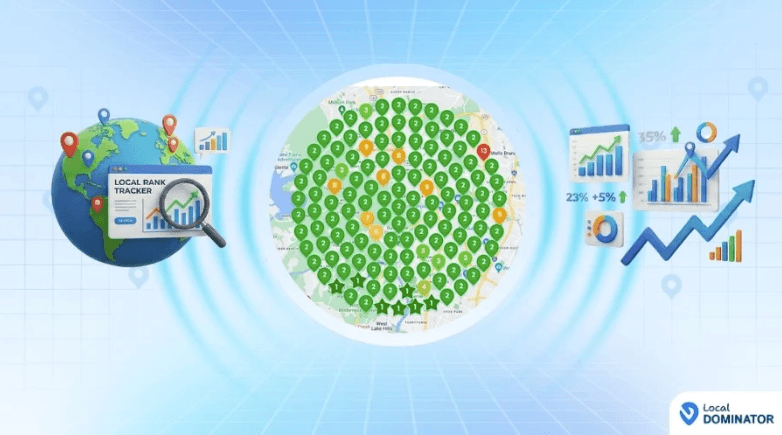
For years, tracking these rankings was a manual task. Business owners would type keywords into Google and hope to see their names. However, search results change based on exactly where the person is standing. A business might rank first for someone across the street but tenth for someone two blocks away. To fix this, companies now use clearer results with automated local rank tracking to understand how their business appears across different search locations.
The Challenge of Manual Local SEO Tracking
Checking your rankings manually is not accurate. Google knows your IP address and your search history. Because of this, it often shows your own website because it thinks it’s relevant. This creates a “bias” in the data. You might think you are ranking well when your customers actually see something different.
Manual tracking also fails to account for distance. Local SEO is hyper-local. Rankings can shift every few hundred yards. To track this without help, you would have to drive around the city and search from different corners. This is impossible for a busy business owner or a marketing agency.
Why Proximity Matters
- GPS Coordination: Google uses precise GPS data from mobile phones to deliver results.
- User Intent: Users looking for immediate services (like a plumber or a cafe) usually choose from the top three results within a 5-mile radius.
- Variable Results: Rankings fluctuate throughout the day based on local traffic and competitor updates.
How Automation Changes the Data
Automated systems remove human error. They use tools that simulate searches from specific GPS coordinates. This provides a “true” look at what a customer sees. Instead of one data point, automation allows you to see hundreds of data points across a specific service area.
By using Automated Local Rank Tracking, businesses can identify “dead zones.” These are areas where the business should be ranking but isn’t. Seeing these gaps allows a team to adjust its strategy. They might need more local citations or better-optimized Google Business Profiles in those specific spots.
See also: How Technology Is Redefining Real Estate Consulting
Understanding the Role of GeoGrids
Traditional rank trackers give you a single number, like “Rank 3.” This is not enough information for local search because a business does not rank the same across an entire city.
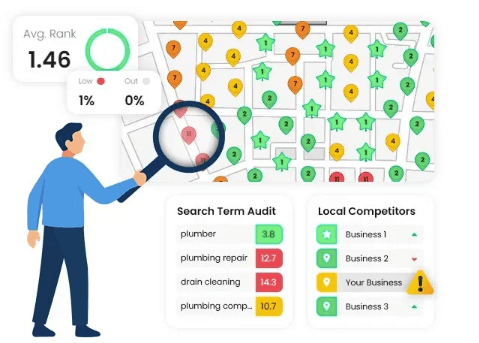
That is why many local SEO teams use a geogrid rank tracker to see local rankings across different areas. It visualizes ranking data on a map by placing a grid over your city. Each point on the grid shows your ranking at that exact location.
Interpreting Grid Data
- Green points: These indicate you are in the top three results (the Map Pack).
- Yellow points: These indicate you are close but not quite in the Map Pack (Positions 4-10).
- Red points: These indicate you are buried deep in the search results (Position 10+).
This visual data is easier to understand than a spreadsheet. It shows exactly where your “radius of influence” ends. If your rankings drop off sharply to the north, you know you need to focus your marketing efforts there.
Why Scale Matters for Agencies
Marketing agencies often manage dozens or hundreds of clients. Manually checking the local rankings for each client is not scalable. It takes too many hours and produces low-quality reports.
With automation, an agency can schedule reports to run daily or weekly. This allows them to spot trends before they become problems. If a competitor suddenly takes over a neighborhood, the agency will see the grid points turn from green to red. They can then take action immediately.
Benefits for Client Reporting
- Visual Proof: Maps show clear progress over time, which is easier for clients to digest than text.
- Efficiency: Automated reporting saves dozens of hours per month compared to manual screenshots.
- Competitive Analysis: Most automated tools allow you to track competitor grids alongside your own.
The Factors that Influence Local Rankings
To improve the data shown in your tracker, you must understand what Google looks for. The three main pillars of local SEO are proximity, relevance, and prominence.
1. Proximity
This is how close the business is to the person searching. While you cannot change your physical address, tracking data helps you understand how far your “reach” actually extends.
2. Relevance
This is how well your business category matches the search term. Using the right keywords in your profile and on your website helps Google understand what you offer.
3. Prominence
This is how well-known the business is. Google looks at reviews, links from other websites, and mentions in local directories (citations). Tracking your progress through an automated system lets you see if these updates are actually working. For example, adding new photos or responding to reviews should eventually lead to more green points on your map.
Data Density and Better Decision Making
High information density is key to a good SEO strategy. You need to know more than just your average rank. To compete in modern search, you need granular data.
- Keyword Intelligence: Identify which specific terms trigger your Map Pack appearance.
- Temporal Tracking: See how your rankings change during business hours versus after hours.
- Competitor Benchmarking: Observe which competitors are gaining ground in your specific neighborhood.
Automated systems collect this data constantly. They provide a “single source of truth.” This means you aren’t guessing based on one or two searches. You are making decisions based on thousands of data points. This reduces the risk of wasting money on marketing tactics that do not work.
Final Thoughts
Local SEO is no longer a simple task. It is a complex game of coordinates and proximity. To stay ahead, businesses must move away from manual checks and embrace technology that provides a real-world view of the search landscape. Using high-quality tracking tools ensures that your marketing budget is spent effectively and that your business remains visible to the customers who are closest to you.
Local Dominator is a cloud-based Search Everywhere Platform specializing in unified local SEO and AI search tracking for local agencies and businesses. It serves as a single source of truth that integrates SERP analytics and citations to make visibility simple, predictable, and scalable across all digital touchpoints.